Monday, 30 July 2018

"Il faut cultiver son jardin." - Candide by Voltaire. 1758


My lavender plants are dying, I feel slighted, pained, a failure and confused. Isn't this lavender weather? Saving or reviving a plant’s life does not equate to saving or reviving a person’s life, of course, but the I think the instinct is similar. It’s paternal or maternal.  It’s not the same but there are elements in common. It’s nurturing, it’s protective, it’s a mutual relationship and if a plant suffers or dies you suffer a little.

These nurturing, parental thoughts came to me yesterday. The pink Hydrangea that appeared last summer has finally flowered this year. Its magnificent pink petals were one of the highlights of last year. All the more so as I didn’t even think I think I liked Hydrangeas, in fact I would have struggled to identify one but it had re-appeared as a result of the clearing work I did in that part of the garden the previous summer. Clearing space allowed it to revive itself in a magnificent display. Metaphors about clearing space literally manifest in a garden at times, allowing us to enjoy the beauty of nature, its power, its ability to have a renaissance.  The gardening metaphors are already there of course. We all know them; “Planting new seeds”, "reaping what you sow", "blossoming career". The French philosopher Voltaire said we need to “cultivate our garden” if we are to make something of our lives. Well that's how I understood it. Perhaps he was being ironic or facetious?  The world was far more savage in 1758 than it is now, though eeerily similar in some ways, so he must have been partly serious surely? Read the book, Candide, you'll know what I mean. I always liked that metaphor, it’s beautiful yet simplistic, it’s economical yet powerful, intimate yet vast. Get to the point, please. It took me to thirty-five to really become an actual gardener and I’m still learning. I’m not sure if Voltaire was interested in gardening, but literally cultivating your garden is one way of getting there.

A garden is an emotional relationship…you take responsibility. It’s holistic and reciprocal. It’s different for different people and as I said, I realise that gardening isn’t saving lives or curing diseases, but collectively if more people get involved it can only be good for the common good. I believe if more people in society took up gardening, discovered the joy and journey that is gardening, the world would be a slightly better place. I'm not a pessismistic satirist like Voltaire. I'm not a genius either but I'm a pragmatist and maybe an idealist. Collective responsibility. That’s not so common these days as we all have it a bit too easy, numbed by multi-media, sensationalism and additives. Just look at the politicians we've voted for or allowed to be voted in due to our collective irresponsability or indifference. I'm just saying. Gardening should be on the programme for every primary school on earth.

Anyway, back to this garden, the other news is the bramble bush. Brambles or blackberries, same thing. I’m not sure we could sell them at the local farmers’ market - not that you’d ever see me at a farmers’ market, I worry the smugness may be contagious – bit tiddly, but great to have fruit literally growing wild in the garden. Another metaphor! Should provide a brief feast for the Woodhouse and maybe a Blackcap if one stops by. Haven’t seen one this summer, sadly. Nice bird. Size of a large Robin, with a light body and a blackcap funnily enough.

Oh and the frog came into the house late last night, I opened the doors stepped out for a second, came back and it had hopped in, had to cajole it back out again. Love frogs, but not in the house, though I’ve probably had less agreeable flat-mates in the past.


Wednesday, 18 July 2018

A "herd" of Goldfinches....


In Gilbert White’s day, Goldfinches were almost certainly a bird of the countryside and not the cities. Today, there’s six of them, two adults and four young on my lawn. Now, there weren’t so many cities in the 18th century, of course, but the only time you were likely to see a goldfinch in the city would be in a cage, their pretty colours and voices charming our ancestors with their slightly different moral code in regard to domestic pets and many other forms of domesticity, for that matter. I actually saw some goldfinches in a cage in Spain a few years ago and was rather shocked, but is it any worse than having a budgie in a cage? The only difference is that budgies are not native birds so our only experience of them is in a cage. Either way, Goldfinches give far more pleasure out of a cage.
Now the reason they were primarily birds of the country was due to diet. They like seeds. Seeds such as thistle seeds and from other plants of fields and waste ground. These days intensive farming and the like have ensured that such food sources are more likely to be found in cities, railways lines etc. than farmland. Goldfinches are a common sight, certainly in London, I see them more than Chaffinches or Greenfinches, a reverse of my experience as a birder in Glasgow in my youth. In fact, I don’t think I ever saw one, this lack or yearning, perhaps the reason for my inventing a game, whereby my friend Colin Dunlop would violently interrupt our Latin class by pretending to share my enthusiasm. I would move over the side of the class that looked out onto gardens, I would shout to Colin that I’d just seen a “herd” of goldfinches – it’s actually a “charm” - and he would shout “where” and run across the room to spot these imaginary birds, leaving desks and chairs in his wake. Very productive that Latin class. Anyway, I digress, the other factor is of course, the human factor. In Britain we like to feed the birds - rather than putting them in cages -  and Goldfinches take advantage with great enthusiasm. Whoever the bright spark is that designed the Goldfinch feeder, he or she is very bright. Probably a he, that’s not sexism, just that I don’t think any woman capable of such extreme geekism.  The slits in the feeder, exactly fit their bills that they traditionally use to extract seeds from plants.  Thus, essentially mimicking, ergonomically, their natural feeding pattern on a plant. Who had the time to think that up? Within a couple of days of me putting this feeder up, the Goldfinches had arrived. How did they know? Amazing.
Anyway the fact that they are feeding on my lawn is what inspired this article. You see, I want this garden to be a natural food source for the birds, not merely an artificial one. So the fact that they‘re using the lawn rather than the feeder is very interesting. There’s no thistles there, sadly. I like Thistles, must the Scot in me, but there’s clover and another little purple flower. This is great, the clover is also very popular with bees, though many have suffered from the heatwave and have dried out but some are going strong. The clovers that is. Bees can suffer in the heat too, BTW, keep an eye out.
Elsewhere, the yellow rose has suddenly burst into life again from no-where, the wild brambles are coming and the tomatoes are still green but this warm sun should continue their metamorphosis. It’s all wunderbar, not Wonderbra as my spellcheck attempted to convince me! Not that there’s anything wrong with a Wonderbra.           
Finally, no takers yet for my bee apartment yet but they do say it’s a difficult time of year for the property market.     
Anyway, best summer in five years, long may it continue but a little bit of rain wouldn’t go amiss. At night too when we’re sleeping if you’re listening, Ming the Merciless…

Thursday, 12 July 2018

Mid-summer garden visitors...


So the colours in the garden may be peaking but the weather’s gone grey. I was beginning to take the blue skies for granted. Always a mistake, don’t take anything or anyone for granted. Always take the time to practise gratitude, Man! I‘m grateful every day for my garden but the harsh truth is that the sun and blue sky just make it better. John Lennon wrote about “sitting in an English garden, waiting for the sun”. He would have waited even longer in Scotland, the point is, he was right, the odds are pretty high on no sun so it’s been all the more amazing this last month. When it’s grey, though everything goes a little quiet, a bit still. The insects like ourselves just seem a bit keener on hanging out, if the sun is out. Still, life goes on.
The birds have, actually, been a bit more active, they seem indifferent to the sun’s presence. I’ve seen blue tits, great tits, blackbirds, magpies, the dreaded woodpigeons, the delightful collared doves, the dunnocks, the ubiquitous robin, a wren, still no summer warblers, sadly, but the swifts continue to thrill, flying through the sky like TIE fighters from Star Wars. Their numbers have augmented too. I saw a screaming frenzy of at least ten fly past this weekend. In addition to my resident frog, we have a wood-mouse, like a normal mouse but with big ears. Very cute, I saw it helping itself to the peanut feeder the other day. Seems to be solitary so like the lonely frog it may have to keep itself entertained.
            An exciting and slightly perturbing visitor the other evening was a Hawker dragonfly. Very large, very fast and quite friendly. They apparently fly close to “investigate”. The other visitor I’m still hoping for has yet to appear. More common in the Mediterranean, the Hummingbird Hawkmoth will familiar to those of you who’ve been to the south of France or Spain. Hovering opposite flowers, to take their nectar, hence the name, they are quite something to behold, but they do sometimes appear in the South-East if the winds favour it. We saw one last year, it was quite surreal and I’m hopeful we’ll see one again, though I wouldn’t bet on it. Another exciting and brief visitor was Britain’s largest hoverfly. You know Hoverflies, like mini bees or wasps, they mimic them to trick potential predators in thinking that they have a sting. The Hornet Hoverfly has taken it to a higher level, actually mimicking in size and colour a hornet. A hornet is Europe’s largest wasp, pretty scary even though they’re pretty docile and fairly rare. Certainly impressive work on the hoverfly’s part. What a clever thing, nature is!
            My venture into the property market that I referred to is not quite what it seems. I purchased a bee apartment. What on earth is that? Well, it’s exactly what it sounds like, a mini-apartment block for solitary bees. They’re less conspicuous than the better known social honey bees partly because they’re much smaller but I love them. They’re also important pollinators. We NEED pollinators. Without them we won’t eat. Honey Bees understandably get the attention because they make honey and that is great but don’t forget the little guys. They're little mini-bees, very cute. They’re very important too. You you can do your bit to help by purchasing a little bee flat. If not, at least have the flowers that all bees love. Lavender, Buddleia, Lobelia, Scabious etc. Keep an eye out for them.
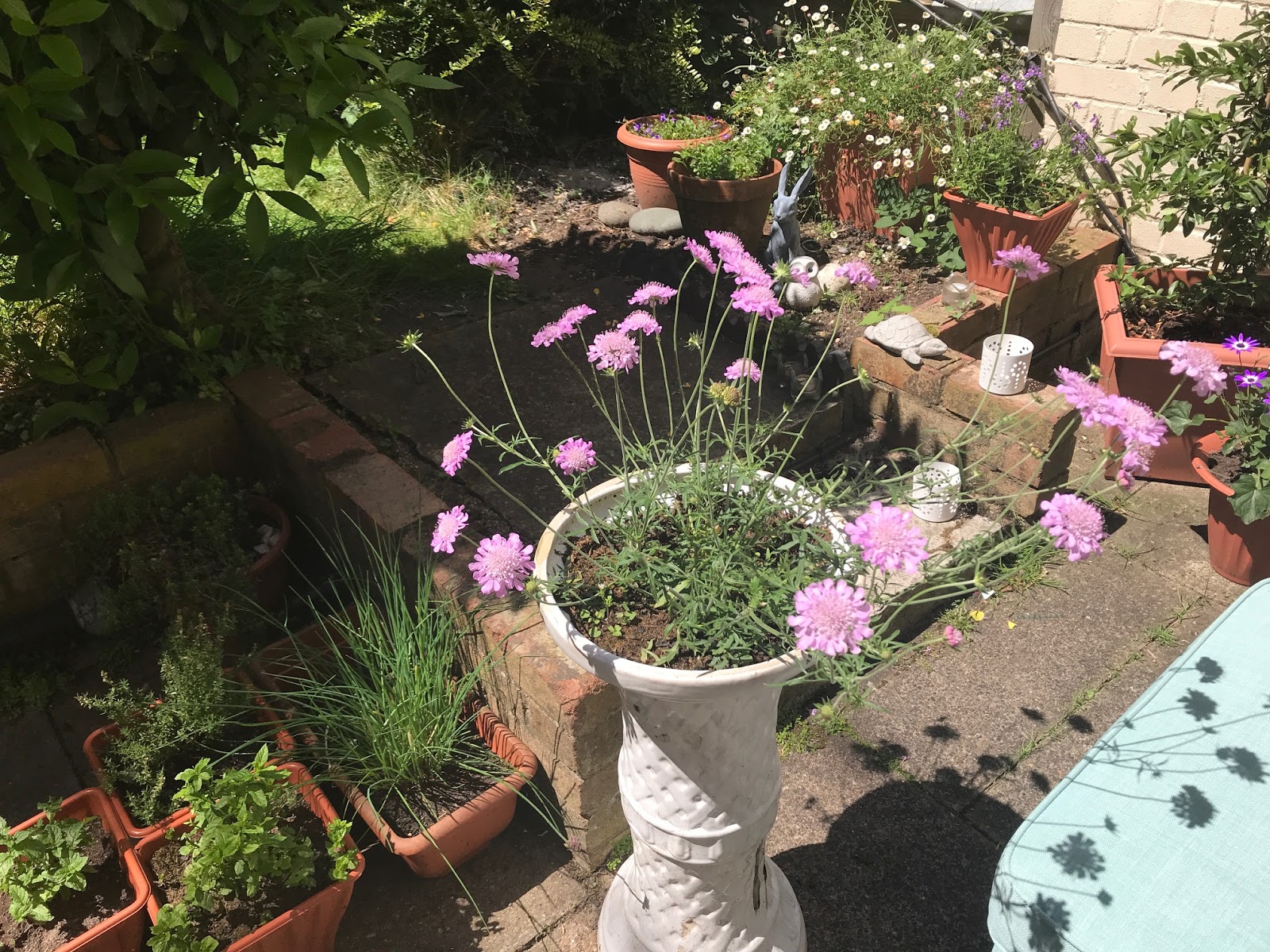
            One other feel good story involves the purple flowers in the picture. The plant almost died but I managed to resurrect it and now it has a regular but solitary visitor. A honey bee which comes every day. It is on the vicinity of the buddleia which is slowly flowering though so that may bring a few more visitors to this particular part of the garden. Anyway, it’s high summer, everything is in bloom, let’s enjoy this moment, it won’t last long; remember what Shakespeare said about summer’s lease.


Thursday, 5 July 2018

It's Wimbledon again. Pimms on the pesticide free lawn anyone...


July 1990. North Gardner street, Glasgow's West End. I’m in my grandmother’s house, Wimbledon is on the TV. I’ve been watching it since 1982. My mum was a fan of Jimmy Connors, I wasn’t.  I will, however, forever remember the final of ’82 against McEnroe. I digress. Back to July 1990. It’s 12 degrees and grey in Glasgow. In London it’s 30 degrees and sunny. Hmmm…I remember thinking. I've always liked that decadent Englishness; Pimms on the lawn, Gin and Tonic in the sun etc. that is, not the public school shenanigans or imperialistic slaughter. Enough of the politics.
July 2013. In London, it’s 30 degrees again and Andy Murray is about to win Wimbledon. Now, it isn’t always 30 degrees in London, heatwaves come and go. The last one was in 2013, as it happens.  Andy won’t win this year sadly, obviously and maybe never again, but that memory is there and will never fade. So back to the heatwave. Over 3 weeks it lasted. Three weeks of the Spanish Plume as they call it. It’s basically hot, hot air from the Azores that crosses over the Spanish mainland and makes it all to way us. Well to London, anyway, not always to Scotland but I believe this year, so far, so good. The Blue Nile, one of my favourite bands, who happen to be from Glasgow, once wrote a song called Heatwave. Seems aptly ironic. Listen to it, if you haven’t heard it, pure magic chorus.
 
https://www.youtube.com/watch?v=PypoQDHG6Kg

            So why all this weather talk? Well we’re in the middle of another heatwave, for those of you on other continents who bother to read my blog. Mediterranean air always feels a little odd, when you’re not in the Mediterranean but a northern European city. Extremely pleasant, but a little incongruous, ultimately, when it lasts so long. Still, I’m not complaining and neither are the pl
 
-ants, until a hosepipe ban comes into force making my watering of them a bit more laborious.

            Not surprisingly, the Mediterranean heat has gone down well with the Mediterranean plants. The Scabious is the bees knees, the Dhalia is literally, in the pink and the Lavender, the Rosemary and Thyme are having a whale of a time and the bees also, as a result.
            Chatting to the lady of the house recently, she concluded that this holy trinity may well be her favourite plants or certainly her favourite herbs, I might have had a Negroni which can affect one’s listening capabilities. I realize Lavender isn't a herb. I cannot disagree with this, they are marvellous plants with unique perfumes and flavour, and dare I say it, personalities. It is, however, dare I also say it, two slightly less glamorous plants that are giving equal pleasure at the moment; Daisies and Clover. I planted the Daisies last year, they not only survived the harsh winter but are positively brimming with life. The clovers have only appeared on the lawn in the last week or so and are very welcome, being particularly reminiscent of my childhood. Of playing football on our back green when I was about 9 or 10. Thinking of that, I think of clovers.  Close contact with grass; a lawn or a park, seems to be something that I did more of as a child, especially a lawn with flowers growing naturally.  That might just be my personal experience but it seems modern gardening and tastes have encouraged prim, weed-free lawns and that has its place but I rather prefer a lawn with some clovers, daisies and buttercups and so on. Obviously if I was playing at Wimbledon, I might be a little less romantic.  Never has an if, been a bigger if.
             Another Mediterranean herb which I love and is also thriving, is the basil. With an extraordinarily heady scent, it’s one of my favourite culinary herbs. It’s lush, green leaves are more reliant on heat and sun than say Thyme or Rosemary so it’s time may be be limited but I’ll enjoy it while it lasts and ensure that the slugs don’t. No pellets in this garden, beer traps only, incidentally, though the dry weather seems to have limited their presence anyway. Fingers crossed.


            The roses remain coy but I think it may be a little English reserve with this undignified and excessive heat. I don’t deal so much with our ornamental garden, that’s the lady’s domaine but I do appreciate what they bring. The petunias have finally appeared, coaxed out, it would seem by this lovely warm air. They have little value for pollinators such as bees and hoverflies but they do provide some wonderful colour and theatricality. Lobelia are equally resplendent but the bees like them which is an added bonus. Look at the insects in your garden. Lots of buzzing things is a good sign. We’ve had some good butterfly sightings this year too. Red Admirals, Cabbage Whites, Speckled wood and a few others including the tiny blue ones. I think few things give me more pleasure at this time of year than a butterfly. Makes you think. What is it this power that can create such beauty and such fragility. Such wistful frivolity and such vulnerability. It's beyond me.
And this weather may even encourage a more exotic and spectacular visitor from Southern Europe in the coming weeks. More of that next time…and of my foray in the property market to try and help the solitary bees and wasps.

Friday, 22 June 2018

Late June, the gardens in full bloom...


Have you read the short story, The Visitor by Roald Dahl? If not, I recommend it. The reason I ask, is to my great pleasure on re-reading it last week, the lead character, in one scene, reads Gilbert White’s Natural History of Selbourne. Those of you familiar with my blog will be familiar with White and I need say no more.           
            Summer really has announced itself this with lots of dry weather and plenty of sun with some overnight rain too. A perfect elixir for the plants to thrive. The Buddleia is almost in full bloom, the jasmine is flowering, the dahlia, rescued following near assassination by slugs is magnificent and the rather unpleasantly named Scabious is in top form, it’s long spindly arms and lilac flowers spreading out in all directions. These flowers are popular with the pollinators thus they are precious as well as giving colour and beauty to the garden. The warm weather has also benefited the lavender. I love lavender, though I know little about it. We have three different types, one of them is French lavender, none are English which I’ve noticed in other peoples’ gardens in magnificent shape. This isn’t racism, purely circumstantial. One in particular is most inspiring having survived the long winter and proclaiming its beauty with disdain for the snows of last March. It’s not quite Provence but nevertheless. Another of my favourite plants, a wild bramble is also doing quite well, it’s lovely white flowers also very popular with bumble bees, in particular.
            The only plant that keeps me waiting is a hydrangea bush.  I don’t actually like hydrangeas, they look like hats elderly women wore in the 60’s and 70’s but this one, I kind of rescued two summers ago, inadvertently when I cleared lots of bushes at the side of the garden allowing it to come back to life last year with beautiful pink flowers. It’s beginning to bloom slowly and enticingly.
            The roses are not flowering particularly in huge numbers but such is the beauty of a single white rose, it’s a case of quality not quantity that keeps me happy.
            As for the herbs, some slugs have given my basil a bit of a pasting, I was a little late and lazy thanks failing to put out a beer trap (very effective) with enough regularity. I’m hoping the basil comes through now that I’ve managed to remember to top up the beer levels on a daily basis. The chive flowers have gone as I knew they would but my lemon thyme has recently flowered. A stunning site, a plethora of purply-pink flowers matching anything in the garden at the moment.  One of my mint plant continues to suffer, the other is doing better, growing so vigorously that whatever beastie is turning the leaves white can’t seem to keep up.
             A warm June is I think, one of the great times of the year in a garden. The plants are perhaps at the peak of their powers, rejoicing in their splendour. There’s not much left of June, if you have a garden, make the most of it.
            The birds are a little less splendrous. Whatever young have are survived still hassling their parents for food. The grown-ups will be looking forward to a much earned break in a month or two. Still no summer visitors to the garden, sadly. I am partial to a Willow Warbler, a delightful little bird and I remain optimistic that one or two will make an appearance. I did see, our friend, Dan the greater spotted woodpecker for a brief moment last week which is always a thrill. And the swifts continue to thrill too, as they screech past high in the sky. And the fellow in the picture, a common frog has been hanging out too. I like frogs very much.  When I say, fellow, I may be wrong, but I felt some kind of brotherly connection with him or her. They live a solitary life outside the breeding season, just chilling and they eat slugs which is good too. Last year there were two, so hopefully some others will join. With no pond, there’s no action possible, however. This garden is for celibate frogs only.

            A garden is a truly splendid thing, ever-changing and ever challenging but the more effort you p

ut in, the more you’ll be rewarded. I wonder if Machiavelli was a gardener?

Monday, 4 June 2018

More Garden Notes...with a slice of pineapple...


"Rough winds do shake the darling buds of May",  according to Shakespeare and he was right, May can be outrageously inclement, but I rather prefer, Richard Hannay’s - well, John Buchan’s technically – description from that fine yarn, The Thirty-Nine Steps, “It was fine May weather, with the hawthorn flowering on every hedge”.  Not the most complex prose ever written but an apt summation of the joys of May.
May was apparently the hottest on record. Didn’t seem that way though there were certainly a few hot spells. That combined with several wet days has seen an explosion of greenery. Even my lavender which I feared for, given my clumsy preening,


is thriving since my last post, albeit in a rather eccentric shape. Sadly, for technical reasons, I have no pictures to prove it. On an even sadder note, my delightful chive flowers’ days are numbered. Chives flowers’ lease, to paraphrase Shakespeare from the afore-quoted sonnet, “hath all too short a date”.
Our “pineapple tree” is also thriving. Not real pineapples of course, this isn’t Kew Gardens – do Pineapples even grow on trees? – but very exotic flowers, which, my friends, the bees love. No idea what the actual tree is called but its flowers are spectacular, though they do distract the bees from what I have on offer, but it’s not all about me. Bees are a bit like cute babies. Don't be upset if they ignore you, just be happy if they're happy. Besides my Buddleia (Buddleja according to some people, no names mentioned, Fe Morris) haven’t yet bloomed and from my experience not many flowers please bees more. It’s a bit like immigration. No controversy intended here; let me explain. We have nice food in this country, there’s some good stuff, but let’s face it, Indian and Chinese are probably better. Maybe the bees feel the same about Buddleia which is also an immigrant, coming I believe from China, a century or two back.
            Regarding the herbs, yet again, my mint is almost destroyed again within a month of planting. I’d been led to believe that was mint was indestructible, but for the third summer in a row it’s been destroyed by one or various beasties or “little bastards” as they’re alternatively referred to. My regular thyme is also looking a bit pasty despite its profusion of flowers recently but my lemon thyme, with the most extraordinary perfume, reminds me of an ice lolly from my childhood, is thriving. The vagaries of plants.
            We did have our first summer summer visitor which is exciting, however, it’s a bit of a cheat as I occasionally see a Blackcap in winter. I've written about them before. It's maybe not the same one, but although, effectively a summer visitor, they often overwinter, mocking our assertions, or maybe they just reckon that a winter on London is easier than flying to the south of Spain. As a wannabe ( and for one year, some time ago) ex-pat, I can confirm that winter in the south of Spain is far preferable, as long as you avoid the Irish bar. The point being, I live in hope of seeing the odd Willow Warbler, Chiffchaff or Garden Warbler, all true symbols of summer and less confused about their lifestyle choice.
            The swifts have been prevalent, I counted 7 yesterday, flying high in the blue sky. Often revealing the presence by their screeching, I never tire of watching them. Today, they’re no-where to be seen as it’s very grey, but they’ll be back as soon the blue sky and warmth return.
            Elsewhere, it's pretty quiet on the bird front. Robins, Tits, Blackbird and so on are still singing a bit and I’m beginning to see the odd fledgling but it’s still pretty quiet. One particularly bedraggled Blue Tit that I see from time to time has my genuine sympathy. For birds, like humans, raising young is pretty tiring and all-consuming. Well so my friends who are parents keep telling me...

Monday, 14 May 2018

Early summer garden notes....


You may recall my referring to Gilbert White in a previous blog. The nature writer and diarist. A hero of mine. I wonder what he would have made of this late spring. An almost non-existent spring. Winter became summer. Finally, with not much in between. Pity really, there’s nothing quite like the warm spring sun in March waking the bees from their hibernation, but that didn’t seem to happen this year.  Now in the second week of May, the sudden burst of greenery announces summer’s arrival. There are, however, still elements which seem to reflect the effects of the long winter. Very few bees; one or two honey bees, one or two bumble bees. This may be simply a reflection of the lack of goodies on offer in my garden or more likely that it will take time for their numbers to build after the freezing weather that lasted long into March. As there aren’t maybe other insects flying around either, this would certainly seem to be the case. I did see a zebra spider today; I don’t know if that’s their name but that’s what I’ve called them since I was a kid. Small black and white spiders that jump about.
            Thankfully there are some good signs from the herbs. My thyme, chives and rosemary are in flower. And my parsley, although not in flower is in rude health, as they say.  Barely two months ago they were covered in snow.  I think amongst my favourite flowers are herb flowers. I’m not sure why? Maybe it’s the Quaker in me, the making the most of our talents principle. Or more likely it’s their subtle beauty, a simple beauty. Nothing too ornamental. Whatever it may be, the sight of an edible herb flowering is a soulful thing. Bees are very keen too. I’m hoping the imminent bounty of chive flowers coming to bloom will encourage them to visit.
In bird terms, things are relatively quiet, the birds are working hard preparing their nests, I suppose. One unusual visitor has given pleasure, however. A pair of greenfinches, easy enough to recognize as they’re green, the male more so than the female, with an unusual call; a kind of nasal ‘tsweeeee’. In my early birdwatching days in Glasgow, greenfinches were always around. I’ve rarely seen them here in two years. The only finches we have regularly are the goldfinches, which probably only come because I bribe with with nyger seeds.  Another welcome sight has been the odd swift. Swifts are the ultimate symbol of summer in the city and one of the last to manifest. Screeching through the air like fighter jets. Extraordinary birds,  they spend most of their life in the air. You’ll only see them if there’s plenty of insects, hence a sign of summer but for now, just the odd one.
The perennials are beginning to thrive too, after six months of winter torpor. The roses are almost in bloom, the anticipation growing. We’ve only had the roses for one year, but already I’m understanding the appeal. To me what was previously a romantic cliché for Valentine’s day losers has become one of my favourite plants. The jasmine foliage is looking healthy too which bodes well for its flowering this summer, for the first time, hopefully.  The buddleja is looking good too. Ironically our neighbour was getting rid of it as it was struggling and we weren’t that bothered as we had a very healthy one. A year later, ours is dead and the neighbour’s one is thriving.  Hmmmm...Buddleja are an odd one, you’ll see them on waste ground, next to train lines in great swathes, swaying in the wind. Thus places where they’re often left uncared for, they tend to invade but they’re great for the garden; bees and butterflies love them. Get yourself one, they come in all colours. One anomaly, is the lavenders. My attempt to prune them in order to encourage growth has had not had quite the required effect. They are budding well, like miniature purple Sideshow Bobs but aesthetically,  it's a shambles.  The lady of the house is not happy with my inadvertent sa


botage and has given them two weeks to sort themselves out. I hope they listen…